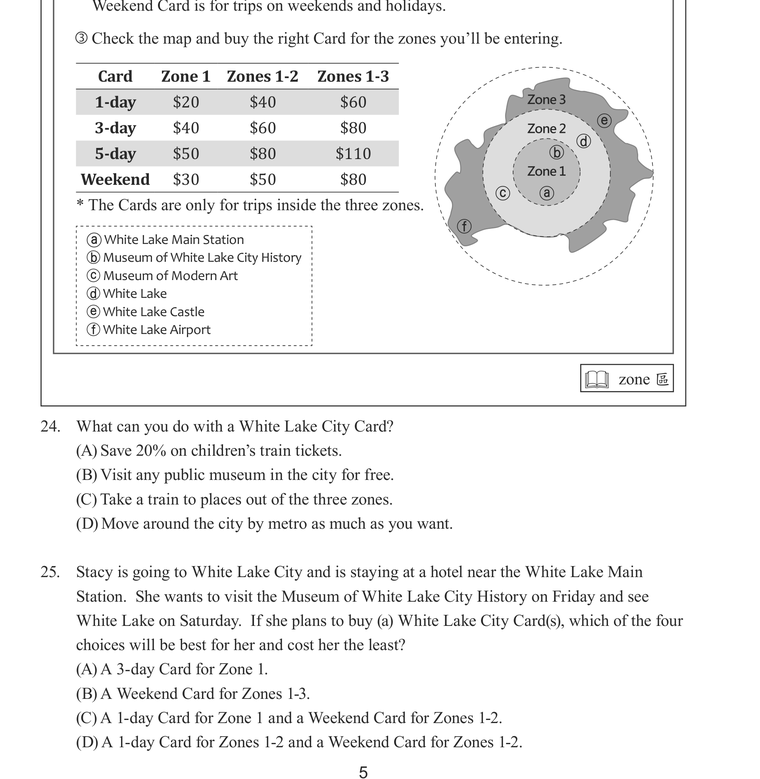
Buy a White Lake City Card When You're in the City(卡片票價表與分區地圖,見圖)
Stacy is going to White Lake City and is staying at a hotel near the White Lake Main Station. She wants to visit the Museum of White Lake City History on Friday and see White Lake on Saturday. If she plans to buy (a) White Lake City Card(s), which of the four choices will be best for her and cost her the least?
(A)A 3-day Card for Zone 1.
(B)A Weekend Card for Zones 1-3.
✓(C)A 1-day Card for Zone 1 and a Weekend Card for Zones 1-2.
(D)A 1-day Card for Zones 1-2 and a Weekend Card for Zones 1-2.
(漫畫,共八格,以下為各格文字內容)
圖1:Around the year 400, people came to Easter Island.(划船上岸的人說:So many trees here!)
圖2:They used trees to make fire and build houses. Because of the trees, people had a great life on the island.
圖3:In their free time, they loved making statues with big rocks. With the trees they cut down, they could move the statues around easily.
圖4:Trees were needed and used in every part of their life. Years passed, and there were fewer and fewer trees on Easter Island.(畫面對比 YEAR 400 的茂密森林與 YEAR 1400 的枯木殘株)
圖5:Without enough trees to keep water under the ground, the land became dry, and plants didn't grow.(兩名瘦弱島民說:I'm thirsty. / And I'm hungry.)
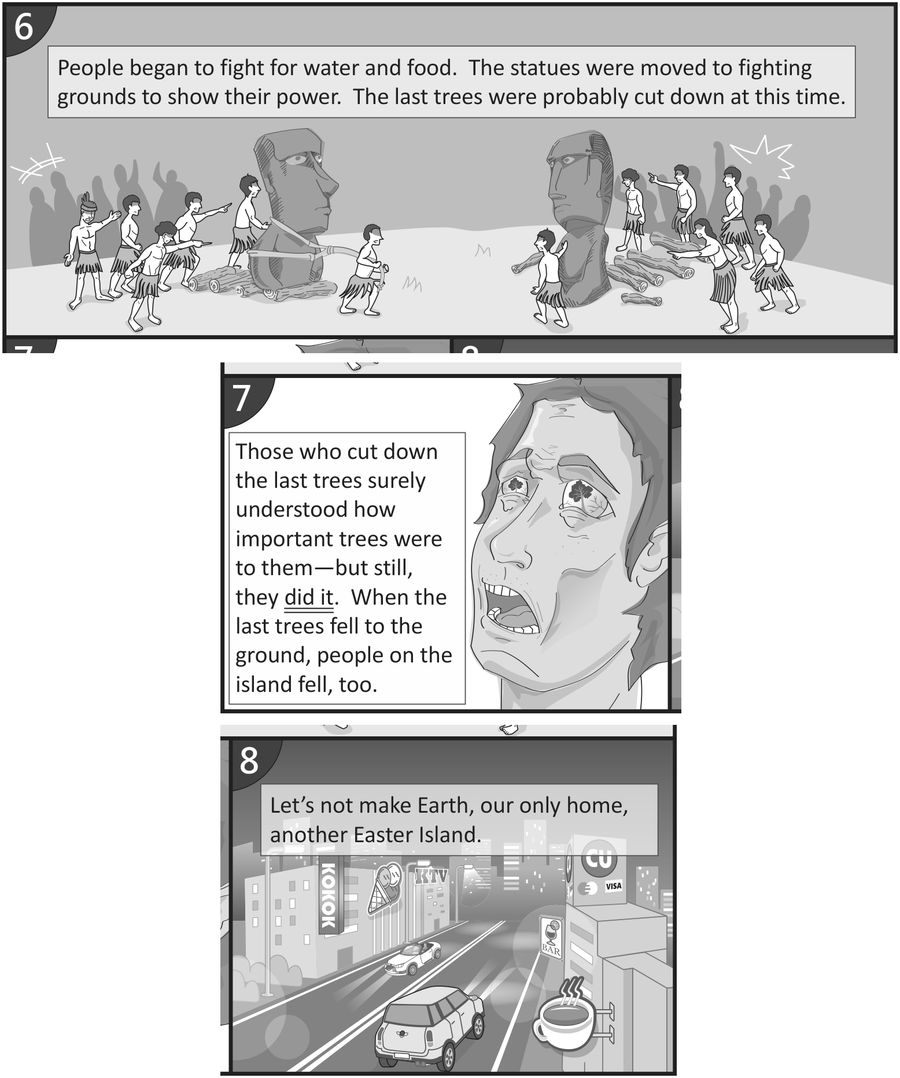
圖6:People began to fight for water and food. The statues were moved to fighting grounds to show their power. The last trees were probably cut down at this time.
圖7:Those who cut down the last trees surely understood how important trees were to them—but still, they did it. When the last trees fell to the ground, people on the island fell, too.
圖8:Let's not make Earth, our only home, another Easter Island.(畫面為現代城市街景)
(圖為一幅漫畫:一名1970年代英國電力工人,嘴巴標註 OPEN ALL THE TIME,胸前心臟處標註 NOTHING HERE,向前伸出的手掌標註 ALWAYS OUT,腋下夾著一份報紙)
In the picture is a UK electricity worker in the 1970s. Pictures like this appeared in many newspapers at the time. In 1972, electricity workers in the UK asked to be paid more, and they decided to stop working until their wish was answered. The government worried that there wouldn't be enough electricity for the country if these workers didn't go to work, so it agreed to give them the pay rise. However, the story didn't end there.
A year later, the electricity workers asked for another pay rise. To get what they wanted, they worked shorter hours and acted like they would walk away from their job anytime. But this time, the government decided to fight. To save electricity, it made new rules for people to follow. For example, each family could turn on the heat in only one room; TV stations had to stop their shows at 10:30 p.m.; businesses could open only three days a week.
People's lives were greatly changed. Without enough heat to keep the house warm, people covered themselves in blankets all the time. Hospitals had to use candles because they couldn't keep all the lights on. Factories couldn't keep their machines working. Many people lost their jobs. For months, people were paying the price while the electricity workers were fighting for their wish. In the end, the government agreed to the second pay rise. This picture shows what many people thought of the electricity workers during the "dark" time.
(加註:electricity 電力;government 政府)
In the UK in the 1970s, what did people most likely think of the UK electricity workers?
(加註:likely 可能)
(A)They were not brave enough to fix their problems.
(B)They worked like robots and never learned to change.
✓(C)They were asking too much and did not know when to stop.
(D)They did not care whether their job might hurt people's health.